

Menopause Induced Insomnia Treatment Market to Reach USD 6.2Bn by 2036 as Guideline-Based Care Drives Steady Adoption
Menopause Induced Insomnia Treatment Market
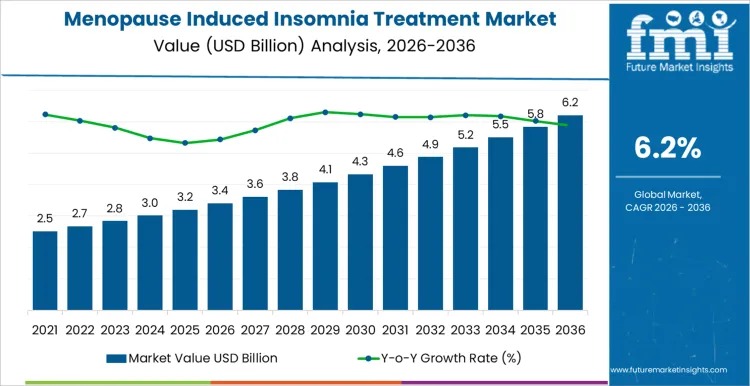
Menopause-induced insomnia treatment market grows from USD 3.4B in 2026 to USD 6.2B by 2036, driven by guideline-based care and clinical adoption.
NEWARK, DE, UNITED STATES, January 19, 2026 /EINPresswire.com/ -- The global menopause induced insomnia treatment market is entering 2026 with a valuation of USD 3.4 billion and is projected to reach USD 6.2 billion by 2036, expanding at a compound annual growth rate (CAGR) of 6.2%. The market’s trajectory reflects steady integration of sleep-focused therapies into menopause care pathways rather than rapid uptake driven by branding or promotional intensity. Growth is being shaped by clinical guidelines, prescriber experience, patient symptom severity, and long-term adherence considerations across healthcare systems.
Menopause-induced insomnia treatments are prescribed and dispensed primarily through hospitals, women’s health clinics, primary care networks, and specialized sleep centers. Clinicians select therapies based on onset of action, safety profile, hormone compatibility, and suitability for long-term use. Once a treatment is embedded into standard care protocols, switching requires clinical justification and formal guideline review, reinforcing predictable and recurring demand.
Market Context: How and Why the Market Is Expanding
The menopause-induced insomnia treatment market is expanding in line with demographic shifts, earlier diagnosis of sleep disturbances, and broader recognition of menopause-related quality-of-life issues. Adoption is influenced more by physician familiarity and guideline endorsement than by overall insomnia prevalence. In 2026, demand remains concentrated in clinical settings where therapy selection is informed by hormonal profiles, comorbidities, and patient preferences.
Healthcare providers increasingly incorporate sleep management into comprehensive menopause treatment plans. This has shifted practice away from generalized sedative use toward targeted pharmacologic and hormone-based interventions, alongside non-hormonal and behavioral approaches. Reimbursement policies and formulary placement continue to shape access and availability, particularly in hospital networks and outpatient programs.
By 2036, as the market approaches USD 6.2 billion, growth is expected to reflect cumulative adoption across telemedicine platforms, multi-site hospital systems, and standardized women’s health programs. The expansion is gradual and protocol-driven, supported by patient education initiatives and consistent clinical outcomes rather than a single regulatory or therapeutic breakthrough.
Key Market Metrics and Structure
• Market Value (2026): USD 3.4 billion
• Forecast Value (2036): USD 6.2 billion
• Forecast CAGR (2026–2036): 6.2%
• Leading Treatment Type: Hormone replacement therapy
• Key Growth Regions: Asia Pacific, North America, Europe
Hormone replacement therapies account for approximately 46% of demand, reflecting their effectiveness in addressing sleep disruption linked to hormonal imbalance. Formulary decisions increasingly weigh sleep outcomes alongside vasomotor symptom control. Non-hormonal drugs provide alternatives for patients with contraindications, while over-the-counter sleep aids serve as adjuncts or entry-level options for mild symptoms.
Clinical Practice and Treatment Evolution
Modern treatment approaches target insomnia driven by declining estrogen and progesterone levels, emphasizing therapies that regulate circadian rhythms and minimize next-day impairment. Selective melatonin receptor agonists, non-benzodiazepine hypnotics, and tailored hormone-based interventions are increasingly preferred over earlier broad sedative options.
Clinicians assess therapies based on efficacy, tolerability, interaction with comorbid conditions, and long-term safety. Treatment effectiveness directly influences adherence, patient satisfaction, and repeat prescribing. Expanded access to diagnostic tools, including sleep studies, supports accurate differentiation when insomnia overlaps with apnea, restless legs syndrome, or medication-related sleep disruption.
Product, Application, and Supplier Responsibilities
Prescription therapies account for roughly 61% of total demand, as patients with moderate-to-severe symptoms require clinician-guided care. Over-the-counter products address self-managed or milder cases, creating stable but lower-volume demand. Product selection determines supplier responsibilities, ranging from dosing guidance and adherence programs for prescription therapies to packaging, labeling, and consumer education for OTC offerings.
Manufacturers and suppliers are evaluated on formulation stability, packaging integrity, dose accuracy, and regulatory compliance. Pharmacies and hospitals monitor inventory levels, expiry dates, and batch traceability, while distribution networks stage stock near high-volume clinics to ensure uninterrupted access. Profitability is linked to predictable reorder cycles and low spoilage rather than aggressive pricing strategies.
Regional Demand Patterns
Demand growth varies by country, reflecting healthcare infrastructure and program expansion. India leads with an 11.3% CAGR, driven by expanding women’s health centers and outpatient clinics. China follows at 11.1%, supported by improved diagnosis and large-scale hospital programs. Brazil records 10.2% growth through private hospital network expansion, while the United States and Germany grow at 8.3% and 8.1%, respectively, within mature, guideline-driven systems.
Explore trends before investing – request a sample report today! https://www.futuremarketinsights.com/reports/sample/rep-gb-31399
Competitive Landscape
Key companies operating in the menopause-induced insomnia treatment market include Pfizer, Bayer, Eisai, Merck, and AbbVie. Competition centers on clinical evidence, safety, adherence support, and integration into established care pathways. Physicians and pharmacists prioritize consistent outcomes, manageable dosing, and reliable supply over minor formulation differences, reinforcing the market’s emphasis on credibility and long-term clinical value.
Key Players in the Menopause Induced Insomnia Treatment Market
• Pfizer
• Bayer
• Eisai
• Merck
• AbbVie
• Others
Browse Related Insights
Menopause Treatment Industry Analysis in India: https://www.futuremarketinsights.com/reports/menopause-treatment-industry-analysis-in-india
Menopause Treatment Market: https://www.futuremarketinsights.com/reports/menopause-treatment-market
Radiation-Induced Fibrosis Treatment Market: https://www.futuremarketinsights.com/reports/radiation-induced-fibrosis-treatment-market
Sudip Saha
Future Market Insights Inc.
+18455795705 ext.
email us here
Legal Disclaimer:
EIN Presswire provides this news content "as is" without warranty of any kind. We do not accept any responsibility or liability for the accuracy, content, images, videos, licenses, completeness, legality, or reliability of the information contained in this article. If you have any complaints or copyright issues related to this article, kindly contact the author above.
