

Healthcare Quality Management Market to Reach US$2.9Bn by 2033 | Persistence Market Research
Healthcare Quality Management Market
Healthcare quality management market growth is driven by data-driven care improvement, regulatory compliance, and rising adoption of analytics &cloud solutions
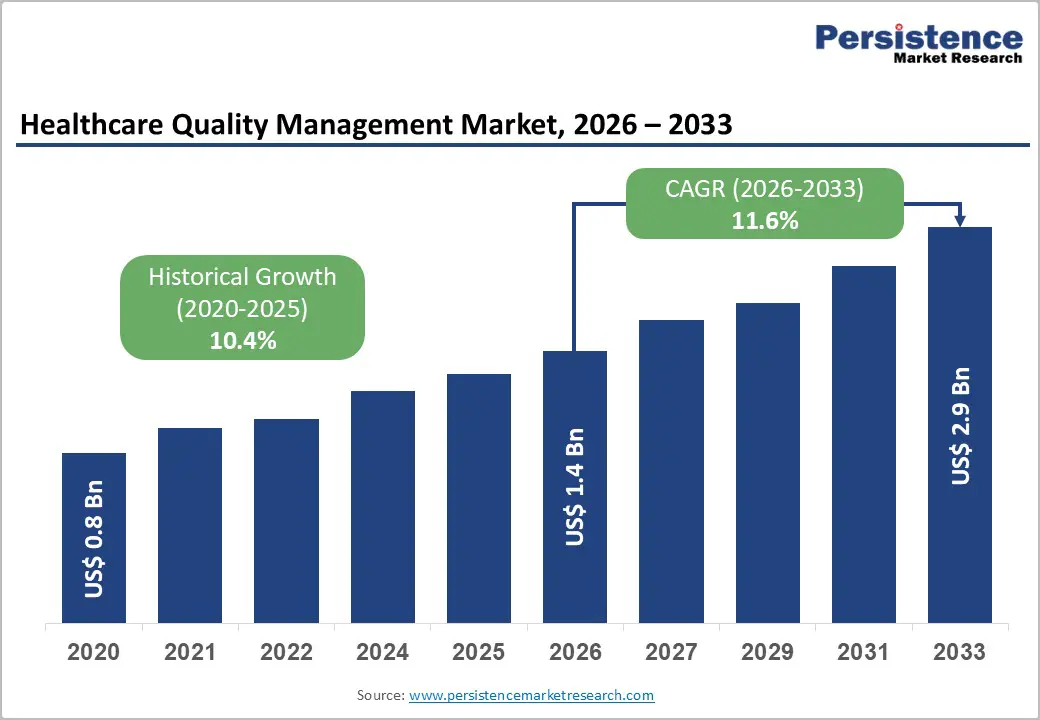
LONDON, UNITED KINGDOM, January 19, 2026 /EINPresswire.com/ -- The global Healthcare Quality Management Market is entering a phase of accelerated growth as healthcare systems worldwide intensify their focus on outcome-based care, operational efficiency, and regulatory compliance. The market is projected to be valued at approximately US$ 1.4 billion in 2026 and is forecast to reach nearly US$ 2.9 billion by 2033, expanding at a robust CAGR of 11.6% during the forecast period from 2026 to 2033. This growth builds on a solid historical expansion rate of 10.4% between 2020 and 2025, reflecting the increasing institutionalization of quality measurement and performance improvement frameworks across healthcare delivery models.
Strategic Importance of Quality Management in Healthcare:
Healthcare providers are operating in an environment marked by rising patient volumes, complex care pathways, and heightened scrutiny from regulators and payers. Quality management solutions have become critical tools for addressing care variability, minimizing clinical risk, and improving patient safety. The increasing availability of structured and unstructured healthcare data has further strengthened the case for systematic quality platforms that enable benchmarking, compliance monitoring, and continuous improvement. Hospitals remain the leading adopters due to their operational complexity and exposure to value-based reimbursement models, while ambulatory care centers are increasingly deploying quality systems to enhance care coordination and reporting accuracy.
Download Your Free Sample & Explore Key Insights: https://www.persistencemarketresearch.com/samples/18655
Market Drivers: Analytics-Led Performance Improvement:
A primary driver of market growth is the rising need for data-driven decision-making and clinical risk reduction. Healthcare organizations are increasingly leveraging business intelligence and analytics platforms to integrate electronic health records, claims data, and operational metrics into unified dashboards. These systems provide actionable insights into treatment outcomes, cost drivers, and workflow efficiency. Providers using analytics-supported quality tools report tangible improvements, including reduced ICU complications, improved adherence to clinical protocols, and optimized patient throughput. The evolution toward predictive analytics is further accelerating adoption, with advanced algorithms supporting early risk detection, patient stratification, and capacity planning. Payers are also expanding usage to detect fraud, reduce readmissions, and monitor provider-level outcome variation.
Restraints: Cost and Workforce Challenges:
Despite clear benefits, adoption remains constrained in certain segments due to cost pressures and workforce limitations. Smaller hospitals, community care centers, and providers in emerging economies often face budget constraints related to licensing, system integration, and staff training. Additionally, the effective use of quality analytics requires skilled professionals such as clinical informaticists and data analysts. Shortages of such talent limit the ability of organizations to fully leverage deployed platforms, resulting in underutilized systems and delayed return on investment. These challenges are particularly pronounced in resource-limited settings, slowing penetration of next-generation quality management technologies.
Get Custom Insights Designed for Your Business: https://www.persistencemarketresearch.com/request-customization/18655
Emerging Opportunities Across Care Continuum:
The scope of healthcare quality management is expanding beyond traditional inpatient metrics into supply chain optimization, telehealth performance tracking, and population health management. Quality analytics are increasingly used to predict drug shortages, reduce procurement risks, and improve vendor performance transparency, directly supporting patient safety and continuity of care. Rapid growth in telehealth and remote patient monitoring is generating new data streams from wearables and digital diagnostics. Integrating these datasets into centralized quality dashboards enables providers to assess virtual care outcomes, adherence levels, and adverse events in real time. Population-level analytics also offer opportunities for public health agencies and payers to track disease trends, vaccination effectiveness, and community risk profiles.
Solution and Deployment Trends:
By solution type, business intelligence and analytics platforms dominate the market, accounting for around 37% share in 2025. Their ability to aggregate multi-source data, compute standardized quality indicators, and deliver real-time performance visibility positions them as core infrastructure for value-based care strategies. Predictive models embedded within BI frameworks support readmission reduction, resource optimization, and patient flow management. From a deployment perspective, cloud-based solutions lead the market with approximately 55–58% share in 2025. Cloud deployment offers scalability, lower capital expenditure, faster implementation, and simplified regulatory updates, making it the preferred model for multi-facility networks and payer organizations.
Regional Outlook:
North America remains the largest regional market, accounting for nearly 38% of total value in 2025. Strong adoption of electronic health records, mature digital infrastructure, and regulatory programs linking reimbursement to quality outcomes underpin regional dominance. The presence of leading vendors and sustained investment in AI-enabled analytics further reinforce market leadership. Asia Pacific is the fastest-growing region, supported by expanding hospital infrastructure, government-led digitization initiatives, and rising adoption of telemedicine and cloud analytics. Cost-efficient IT ecosystems and centralized quality programs across private healthcare networks are accelerating uptake across the region.
Checkout Now & Download Complete Market Report: https://www.persistencemarketresearch.com/checkout/18655
Companies Covered in Healthcare Quality Management Market:
Cerner Corp.
McKesson Corp.
Premier, Inc.
Nuance Communications, Inc.
Altegra Health, Inc.
CitiusTech Inc.
Dolbey Systems, Inc.
Surescripts, LLC
Medisolv, Inc.
Quantros, Inc.
Truven Health Analytics
Others
Market Segmentation:
By Software
Business Intelligence & Analytics Solutions
Physician Quality Reporting Solutions
Clinical Risk Management Solutions
Provider Performance Improvement Solutions
By Delivery Mode
Cloud
On-premise
By Application
Data Management
Risk Management
By End-user
Hospitals
Ambulatory Care Centers
Payer
ACOs
Others
By Region
North America
Europe
East Asia
South Asia and Oceania
Latin America
Middle East and Africa
Competitive Landscape
Strategic partnerships, acquisitions, and product enhancements focused on predictive analytics, telehealth quality monitoring, and supply chain intelligence continue to shape competitive dynamics. Recent developments, such as AI-driven healthcare delivery platforms and advanced clinical workflow tools, highlight the market’s shift toward intelligent, scalable, and outcome-focused quality management solutions.
Read Related Reports:
Alternative Cancer Treatment Market: The global alternative cancer treatment market is set to grow from US$18.2 Bn in 2026 to US$34.4 Bn by 2033, registering a CAGR of 9.5%.
Narcotic Analgesics Market: The global narcotic analgesics market is expected to grow from US$32.8 Bn in 2026 to US$53.9 Bn by 2033, registering a 5.2% CAGR during 2026–2033
Persistence Market Research
Persistence Market Research Pvt Ltd
+1 646-878-6329
email us here
Visit us on social media:
LinkedIn
Instagram
Facebook
YouTube
X
Legal Disclaimer:
EIN Presswire provides this news content "as is" without warranty of any kind. We do not accept any responsibility or liability for the accuracy, content, images, videos, licenses, completeness, legality, or reliability of the information contained in this article. If you have any complaints or copyright issues related to this article, kindly contact the author above.
