

Demand for Bone Densitometers in South Korea to Reach USD 17.3 Mn by 2036, Driven by Aging Preventive Care Expansion
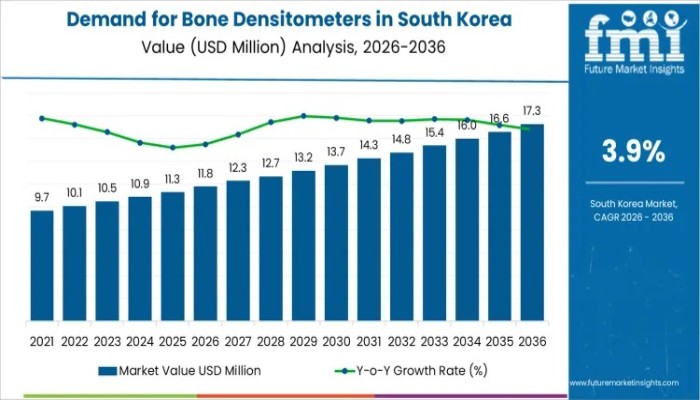
Demand for Bone Densitometers in South Korea
Densitometer sales in South Gyeongsang may grow at 4.1% CAGR, driven by industrial health screening and musculoskeletal care for a labor-intensive workforce.
NEWARK, DE, UNITED STATES, January 21, 2026 /EINPresswire.com/ -- Demand for bone densitometers in South Korea is entering a sustained growth phase, shaped by demographic aging, preventive healthcare policies, and continued investment in advanced diagnostic infrastructure. According to the latest industry outlook, the market is expected to be valued at USD 11.8 million in 2026 and rise to USD 17.3 million by 2036, expanding at a compound annual growth rate (CAGR) of 3.9% over the forecast period.
This growth reflects structural changes in South Korea’s healthcare system, where early diagnosis of osteoporosis and fracture risk management has become a clinical priority rather than a reactive intervention.
Discover Growth Opportunities in the Market – Get Your Sample Report Now
https://www.futuremarketinsights.com/reports/sample/rep-gb-31640
Who Is Driving the Market and Why It Matters
The primary drivers of demand are hospitals, diagnostic imaging centers, and specialty clinics responding to a rapidly aging population. South Korea is among the fastest-aging societies globally, significantly increasing the prevalence of osteoporosis and osteopenia among older adults. National health insurance policies that support routine screening for post-menopausal women and seniors are accelerating equipment adoption across medical institutions.
At the same time, lifestyle changes associated with urbanization—reduced physical activity and dietary shifts—are expanding bone health concerns into younger demographics. Corporate wellness programs and public awareness campaigns emphasizing the “silent” progression of osteoporosis are broadening the screening base beyond traditional geriatric care.
Market Snapshot: Key Facts and Figures
Quick Stats – Demand for Bone Densitometers in South Korea
• Market value (2026): USD 11.8 million
• Forecast value (2036): USD 17.3 million
• CAGR (2026–2036): 3.9%
• Leading product segment: Axial bone densitometers (65.0%)
• Leading technology: DXA (54.7%)
• Leading end user: Hospitals (45.8%)
• High-growth regions: Jeju, South Gyeongsang, South Jeolla, North Jeolla
How Technology Is Reshaping Bone Density Diagnostics
Technological innovation is steadily improving the clinical value of bone densitometry. DXA systems enhanced with artificial intelligence are being adopted to increase measurement precision and streamline workflows. These systems support radiologists by identifying subtle vertebral fractures and enabling more accurate fracture risk prediction.
The integration of AI-based osteoporosis screening tools allows clinicians to move from isolated measurements to longitudinal patient monitoring. In a healthcare environment with advanced digital health records, software compatibility and automated analysis are becoming decisive purchasing factors for South Korean providers.
Why Axial Bone Densitometers Dominate Procurement
Axial bone densitometers account for 65.0% of total demand, reflecting their central role in diagnosing osteoporosis at clinically significant sites such as the hip and lumbar spine. Korean clinical guidelines strongly favor central DXA scans for definitive diagnosis and treatment monitoring.
Reimbursement structures further reinforce this preference, as comprehensive central scans are more consistently covered under national insurance frameworks. Although these systems require higher upfront investment and dedicated space, their diagnostic reliability makes them indispensable in hospital settings.
DXA Remains the Standard of Care
DXA technology leads with a 54.7% market share, supported by its status as the global reference standard for bone mineral density assessment. Its low radiation dose and strong alignment with World Health Organization guidelines ensure continued clinical acceptance.
Ongoing improvements, including faster scan times and enhanced image resolution, allow DXA systems to meet the needs of high-throughput radiology departments while maintaining diagnostic accuracy.
Hospitals Anchor Demand Across End Users
Hospitals represent 45.8% of total consumption, acting as primary centers for managing complex geriatric and orthopedic cases. University hospitals and large general hospitals integrate densitometry into broader diagnostic pathways, enabling immediate treatment decisions by endocrinologists and orthopedic specialists.
Patients also show a strong preference for hospital-based comprehensive health evaluations, reinforcing consistent utilization of high-end densitometry systems.
Regional Outlook: Where Growth Is Accelerating
Growth patterns vary by region, reflecting demographic profiles and healthcare investment priorities:
• Jeju (CAGR 4.7%): Driven by medical tourism, wellness-focused branding, and an aging local population, Jeju is investing heavily in premium preventive diagnostics.
• South Gyeongsang (CAGR 4.1%): Industrial health programs and occupational screening for aging workforces are supporting strong institutional demand.
• South Jeolla (CAGR 3.7%): High elderly population density is prompting public investment in accessible diagnostic equipment, including portable systems.
• North Jeolla (CAGR 3.1%): Gradual modernization of diagnostic infrastructure is narrowing the healthcare quality gap with metropolitan regions.
Competitive Landscape and Strategic Positioning
The market features a mix of global leaders and specialized manufacturers:
• GE Healthcare holds a leading position with approximately 22.0% share, leveraging integrated women’s health and imaging portfolios.
• Hologic, Inc. focuses on precision analytics and high-resolution imaging for academic and research-driven institutions.
• Swissray International, DMS Imaging, and BeamMed target niche segments with compact, cost-efficient, or ultrasound-based solutions.
Local service capability, regulatory compliance, and software integration are key differentiators in procurement decisions across South Korea.
Outlook Through 2036
Demand for bone densitometers in South Korea is expected to grow steadily rather than explosively, underpinned by structural healthcare needs rather than cyclical factors. Preventive care adoption, regional healthcare investment, and incremental technological improvements will define the market’s trajectory through 2036, positioning bone densitometry as a core component of the country’s diagnostic infrastructure.
Why FMI: https://www.futuremarketinsights.com/why-fmi
Related Reports Insights from Future Market Insights (FMI)
Native Septic Arthritis Treatment Market https://www.futuremarketinsights.com/reports/native-septic-arthritis-treatment-market
Menopause Induced Insomnia Treatment Market https://www.futuremarketinsights.com/reports/menopause-induced-insomnia-treatment-market
Medical Devices Surface Active Coatings Market https://www.futuremarketinsights.com/reports/medical-devices-surface-active-coatings-market
Medical Sharps Market https://www.futuremarketinsights.com/reports/medical-sharps-market
About Future Market Insights (FMI)
Future Market Insights, Inc. (FMI) is an ESOMAR-certified, ISO 9001:2015 market research and consulting organization, trusted by Fortune 500 clients and global enterprises. With operations in the U.S., UK, India, and Dubai, FMI provides data-backed insights and strategic intelligence across 30+ industries and 1200 markets worldwide.
Sudip Saha
Future Market Insights Inc.
+1 347-918-3531
email us here
Legal Disclaimer:
EIN Presswire provides this news content "as is" without warranty of any kind. We do not accept any responsibility or liability for the accuracy, content, images, videos, licenses, completeness, legality, or reliability of the information contained in this article. If you have any complaints or copyright issues related to this article, kindly contact the author above.
