

In Search of Expertise: Government-to-Business Transitions and the Architecture of Global Power
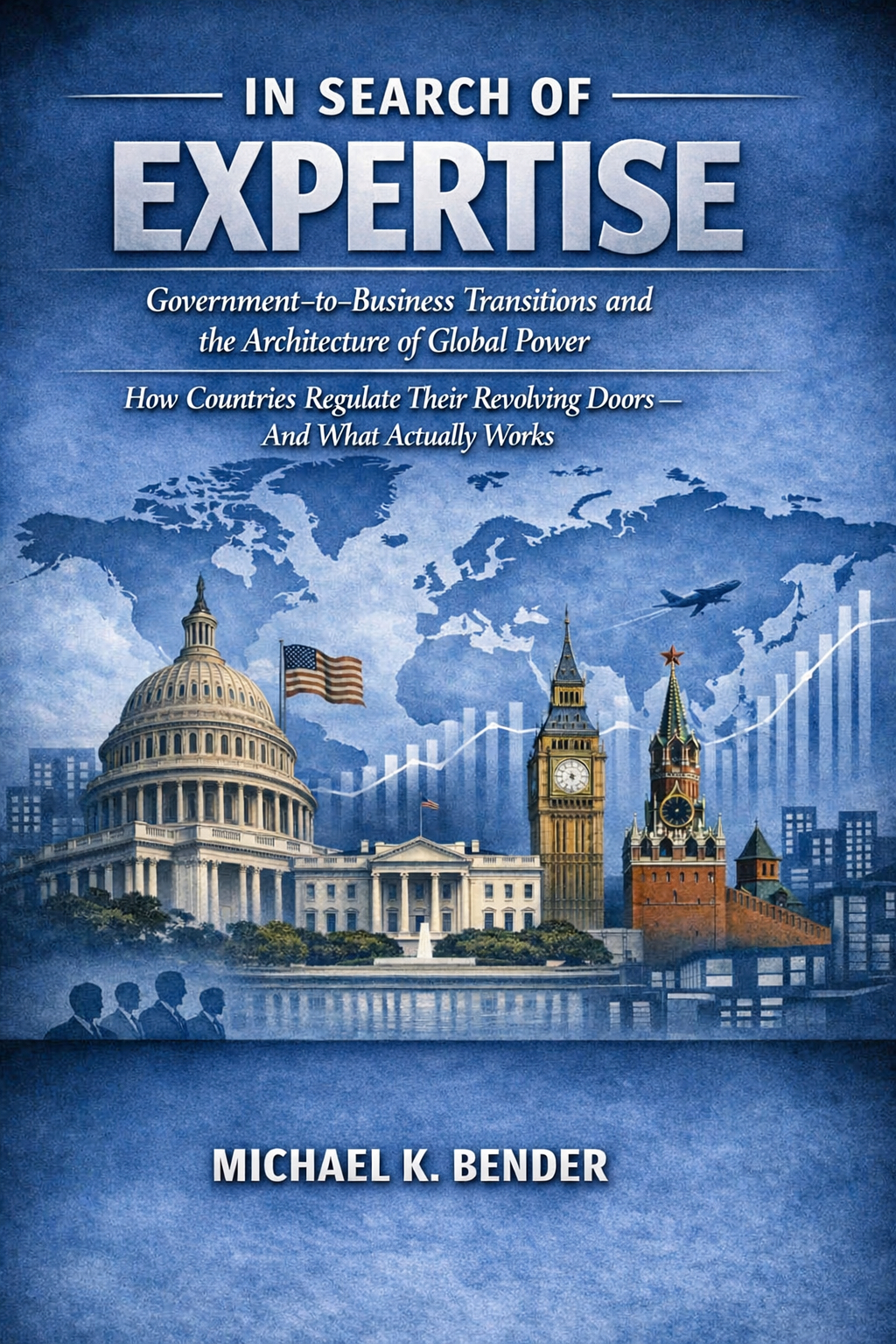
In Search of
How Countries Regulate Their Revolving Doors and What Actually Works
Germany, Scandinavia, and South Korea prove that meaningful reform is achievable when specific conditions align.”
CAIRO, NY, UNITED STATES, April 30, 2026 /EINPresswire.com/ -- When government officials leave public service and transition to private sector roles, they carry expertise, relationships, and insider knowledge that corporations pay millions to access. This phenomenon operates across every political system—from Washington to Beijing, from London to Moscow—yet every country's regulatory approach fails to prevent the conflicts of interest and elite enrichment these transitions create.— Michael K Bender
"In Search of Expertise: Government-to-Business Transitions and the Architecture of Global Power" provides the first comprehensive analysis of how 22 countries plus the European Union manage these transitions—and why they consistently fail. Drawing on forty years of research, observation, and experience across international business, government service, and diplomacy, the book reveals why informal networks matter more than formal rules everywhere, how cultural attitudes determine what's visible as a problem, and what Germany, Scandinavia, and South Korea teach us about what actually works when political will exists to enforce meaningful restrictions.
Universal Patterns Across All 22 Countries
Three universal patterns emerge: **First, informal networks consistently matter more than formal rules.** France institutionalizes transitions through "pantouflage", treating government-business circulation as serving national interests. Britain relies on old boy networks operating through discretion. China uses Communist Party control to manage transitions as instruments of state power. Russia operates through siloviki networks, where former security service officers dominate both government and business. Japan normalizes "amakudari" as a cultural tradition. The mechanisms differ fundamentally, but personal relationships and elite networks consistently supersede formal regulations everywhere.
Second, enforcement becomes the defining variable—not rule sophistication. Germany has comprehensive restrictions but struggles with creative workarounds. South Korea strengthened enforcement after the 2016 political crisis and achieved measurable change. Scandinavia relies on radical transparency and social pressure rather than complex regulations. Countries that succeed aren't those with the most elaborate legal frameworks—they're the ones with political will to enforce them, adequate resources for ethics bodies, and public support even when enforcement becomes politically uncomfortable.
Third, cultural attitudes determine what's visible as a problem. France celebrates government-business circulation as patriotic service. Germany views it with deep skepticism rooted in historical trauma. Japan treats it as appropriate career development. India recognizes conflicts exist but lacks institutional capacity to enforce restrictions. These cultural differences shape whether conflicts of interest are even recognized as requiring regulation.
Fourth—and critically—intelligence officer transitions receive inadequate restrictions across the board. From CIA officers joining defense contractors to MI6 officers becoming corporate advisors to Chinese intelligence personnel transitioning to state-owned enterprises, these transitions create acute national security risks yet operate with minimal oversight in every country examined. This represents a universal regulatory gap across all political systems.
Case Studies Illustrating Systemic Failures
Gerhard Schröder, working openly for Russian interests through Rosneft after serving as German Chancellor, exposes the limits of even Germany's strong regulatory framework. Liu Zhijun, converting his position as Chinese Railways Minister into a family business empire, reveals how revolving doors operate within Party control mechanisms. Peter Mandelson's relationship with Jeffrey Epstein and subsequent U.S. ambassadorship exposed failures of the British old boy network.
What Actually Works
Germany, Scandinavia, and South Korea prove that meaningful reform is achievable when specific conditions align: political independence for ethics bodies, adequate resources to fight legal battles, and public support even when politically uncomfortable. Intelligence officers require five-year cooling-off periods and lifetime bans on working for adversarial foreign governments. Military procurement officials need three-year restrictions and lifetime bans on specific programs they oversaw. Regulatory officials require lifetime bans on working for companies they directly regulate.
About the Author
Michael K. Bender has spent more than forty years examining government-to-business transitions across three different careers: international business, government service, and diplomacy. The research began with a teenage question about French "pantouflage" and evolved into a comprehensive comparative analysis spanning 22 countries. He is the author of: "The Gilded Cage: Reminiscences of a Shadow Man and Go Global Without Going Broke: The practical, budget-conscious playbook for marketing across borders—featuring 31-country resource directory and real-world case studies."
In Search of Expertise is available from Amazon at: https://www.amazon.com/dp/B0GYF6VSXM
Michael Bender
Michael K Bender
+1 518-704-1688
email us here
Legal Disclaimer:
EIN Presswire provides this news content "as is" without warranty of any kind. We do not accept any responsibility or liability for the accuracy, content, images, videos, licenses, completeness, legality, or reliability of the information contained in this article. If you have any complaints or copyright issues related to this article, kindly contact the author above.
