

The Microlending Market Is Projected to Grow to $431.78 Billion by 2030 Fueled by Increasing Industry Demand
Microlending Market Overview
Microlending Market Size and Share
Microlending Market Growth Forecast
The Business Research Company's The Microlending Market Is Projected to Grow to $431.78 Billion by 2030 Fueled by Increasing Industry Demand
LONDON, GREATER LONDON, UNITED KINGDOM, October 14, 2026 /EINPresswire.com/ -- "The microlending sector is rapidly evolving as part of the broader financial services landscape, with promising prospects for the coming decade. As digital technologies and financial inclusion initiatives expand, this market is poised to play an increasingly important role in supporting underserved populations and small-scale businesses worldwide. Here is a detailed overview of the microlending market’s current status, growth drivers, leading players, and regional outlook through 2030.
Microlending Market Size and Growth Outlook
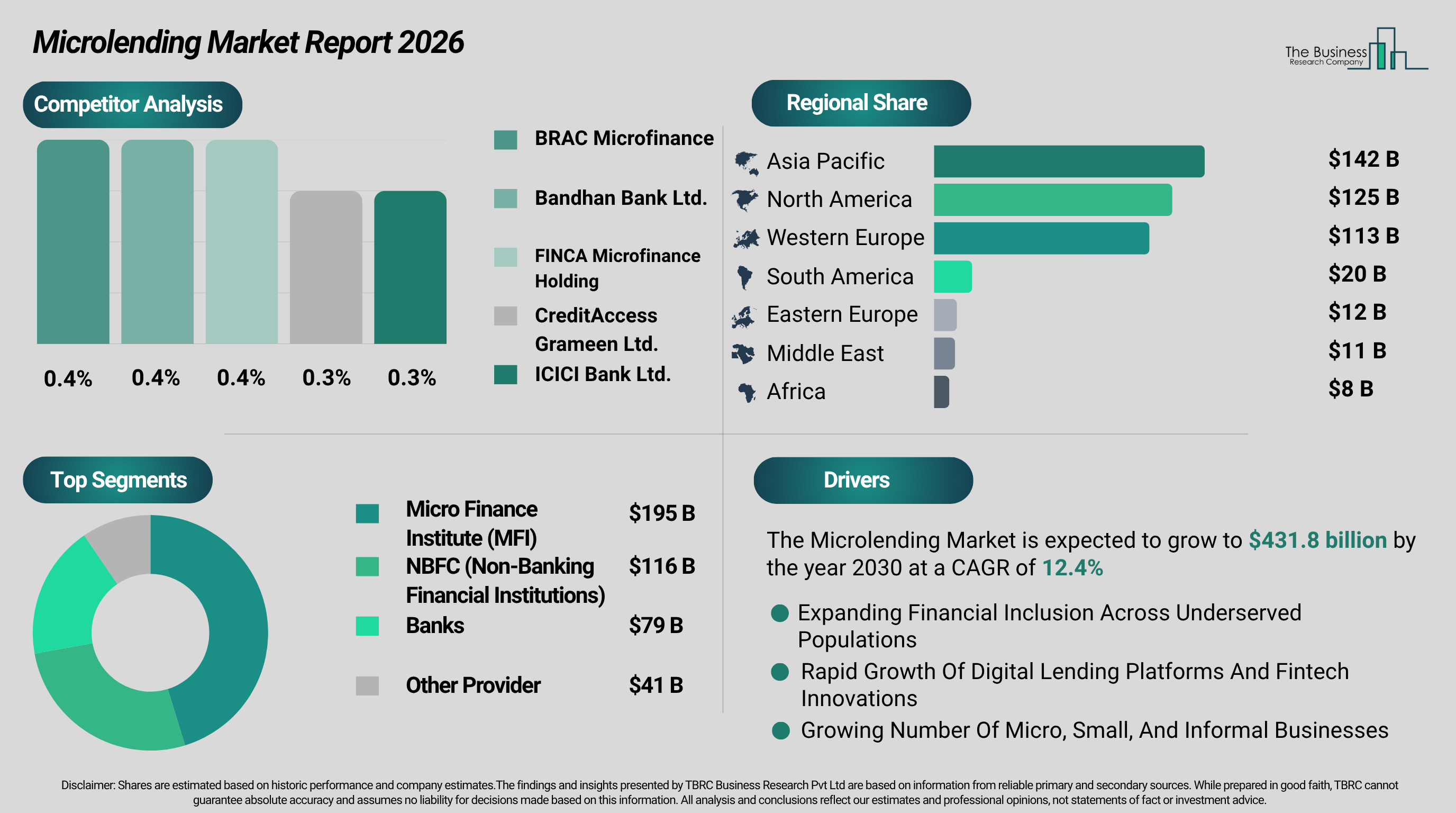
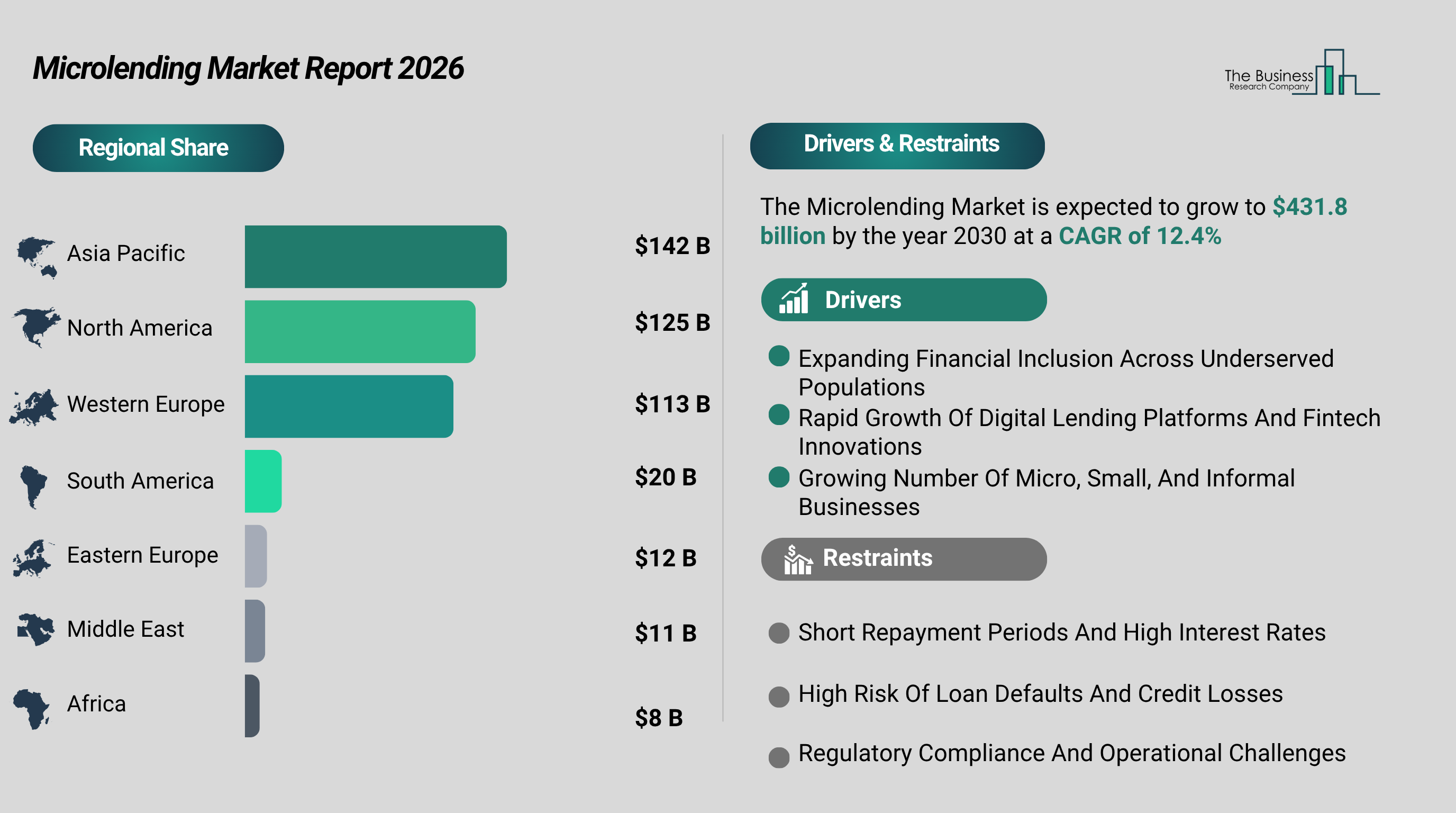
The microlending market is projected to surpass $432 billion by 2030. Within the vast Financial Services industry, which is expected to reach $50,609 billion by that year, microlending will constitute nearly 1% of the total market value. Analysts anticipate a steady compound annual growth rate (CAGR) of 12% leading up to 2030. Asia-Pacific is forecasted to be the dominant region by market size, reflecting strong demand and financial inclusion efforts. By 2025, BRAC Microfinance is set to maintain its position as the leading company with a 0.4% market share, while the top 10 players combined will hold about 2% of the market.
Request A Free Sample Of The Microlending Market Report
https://thebusinessresearchcompany.com/sample_request?id=61510481&type=smp&name=Microlending%20Market%20Report%202026&utm_source=EINPresswire&utm_medium=Paid&utm_campaign=Oct_PR
Main Drivers Fueling Microlending Market Expansion
One of the primary forces accelerating microlending growth is the drive toward expanding financial inclusion for underserved populations. Governments, lenders, and fintech firms are increasingly offering formal credit options to unbanked and underbanked individuals through inclusive programs, often facilitated by digital platforms. These small loans enable low-income households, rural communities, and micro-entrepreneurs to fulfill personal and business needs, thereby fostering greater participation in the economy. This factor alone is expected to contribute roughly 2.4% annual growth to the market.
Another key factor supporting expansion is the rapid advancement of digital lending platforms and fintech innovations. Technologies such as artificial intelligence, alternative credit scoring, mobile banking applications, and digital identity verification streamline the loan process, making it faster, more accessible, and less costly. This efficiency allows lenders to serve a broader customer base effectively. The impact of these digital advancements will add about 2.2% annual growth to the microlending sector.
Access The Detailed Microlending Market Report Here
https://thebusinessresearchcompany.com/report/microlending-global-market-report?utm_source=EINPresswire&utm_medium=Paid&utm_campaign=Oct_PR
The Rise of Small and Informal Enterprises as Growth Catalysts
The increasing number of micro, small, and informal businesses worldwide is also driving demand for microlending. These entrepreneurs often face challenges securing traditional loans due to lack of collateral or formal credit history. Microloans offer a practical financing solution that supports business expansion, income generation, and local economic development. This segment is anticipated to boost the market by approximately 1.9% annually.
Microlending Market Segments with a Focus on Providers
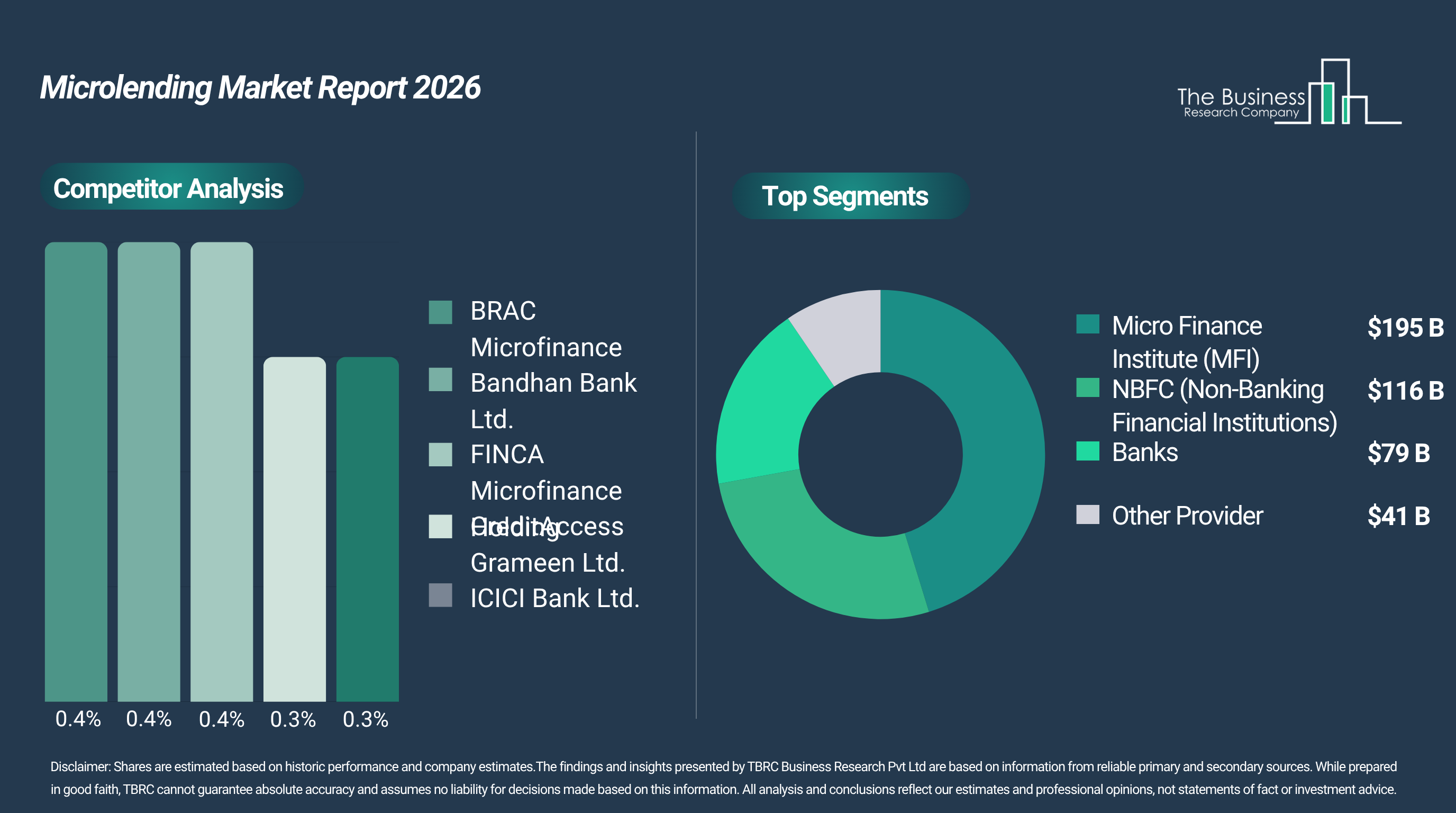
The microlending market is segmented by provider types including banks, microfinance institutes (MFIs), non-banking financial companies (NBFCs), and others. Among these, the MFI segment is expected to dominate in 2030, capturing 45% of the market or around $195 billion. This leadership is driven by MFIs’ outreach to rural and semi-urban borrowers, focus on financing women-led ventures, use of group lending schemes that enhance repayment rates, and strategic partnerships with digital finance providers that make loans more accessible and affordable.
Additional Market Segment Breakdown
The microlending market is also categorized by loan type, including working capital loans, term loans, emergency or unsecured loans, project-based loans, and instant microloans. In terms of end-users, the market serves small enterprises, microenterprises, solo entrepreneurs, and self-employed individuals, each with distinct financing needs and growth potential.
Asia-Pacific Positioned as the Leading Region by 2030
Asia-Pacific is set to be the largest regional market for microlending by 2030, valued at approximately $142 billion, up from $80 billion in 2025. This robust growth, with a CAGR of 12%, is driven by extensive financial inclusion programs targeting underserved groups, widespread smartphone adoption enabling access to digital lenders, strong demand for small loans from low-income households and entrepreneurs, as well as government-backed schemes facilitating formal credit access.
United States Emerges as the Top Country Market
The USA is projected to be the largest country-specific microlending market in 2030, reaching $114 billion from $68 billion in 2025, with an 11% CAGR. Factors contributing to this growth include the increasing adoption of digital lending platforms by small businesses, demand for financing options beyond traditional banks, investments in fintech-based credit assessment tools, and tailored loan products targeting self-employed individuals and startups.
Competitive Environment in the Microlending Industry
The microlending market landscape features both global financial institutions and specialized microfinance providers. These organizations continuously develop digital loan platforms, AI-driven credit evaluation tools, mobile loan disbursement systems, and enhanced risk management capabilities to broaden their reach and promote financial inclusion. Critical to their competitive edge are compliance with regulations, responsible lending practices, accessibility, and integrated digital payment and analytics solutions. Understanding this competitive framework helps stakeholders identify opportunities for innovation, partnerships, and expansion within this dynamic sector.
Leading Market Players and Their Shares
In 2025, BRAC Microfinance held the largest global market share at 0.4%, according to The Business Research Company. This division offers microloans, small business financing, agricultural credit, and inclusion services aimed at low-income individuals, rural communities, and underserved groups via sustainable and accessible lending methods. The microlending market remains highly fragmented, with the top 10 companies collectively controlling only 2% of total revenue. Low entry barriers and varied regional financial regulations contribute to this diversity.
Market Shares of Key Competitors in 2025
- BRAC Microfinance: 0.4%
- Bandhan Bank Ltd.: 0.4%
- FINCA Microfinance Holding: 0.4%
- CreditAccess Grameen Ltd.: 0.3%
- ICICI Bank Ltd.: 0.3%
- BancoSol: 0.2%
- ESAF Small Finance Bank: 0.2%
- Ujjivan Small Finance Bank Ltd.: 0.1%
- Equitas Small Finance Bank Ltd.: 0.1%
- Grameen Bank: 0.1%
Digital Lending Platforms Revolutionizing Access
The rise of digital lending platforms is significantly reshaping the microlending market by enhancing financial inclusion, accelerating loan approvals, and increasing accessibility for underserved borrowers. For instance, in December 2025, Rapid Money launched a digital platform offering short-term personal loans up to ₹50,000. The platform employs a bureau-based approval engine, personalized loan offers, and supports web and Android applications to simplify borrowing while promoting responsible lending practices.
Growth Opportunities Looking Ahead to 2030
The provider segments including microfinance institutes, NBFCs, banks, and others collectively represent major growth opportunities, expected to add over $190 billion in market value by 2030. Specifically, MFIs are forecasted to grow by $86 billion, NBFCs by $50 billion, banks by $35 billion, and other providers by $19 billion between 2025 and 2030. Innovations such as embedded finance, automated credit risk assessment, mobile-first lending in emerging markets, and strategic collaborations between fintech and traditional institutions are anticipated to fuel this expansion.
Effective Strategies for Success in Microlending
Key approaches for market participants include advancing digital microlending platforms to broaden financial inclusion, leveraging alternative credit evaluation methods to enhance risk management, expanding mobile lending services to improve convenience and credit access, and integrating AI technologies to refine credit scoring and fraud detection.
Key Players Driving Market Dynamics
Some of the prominent entities shaping the microlending market are BRAC Microfinance, Bandhan Bank Ltd., FINCA Microfinance Holding, CreditAccess Grameen Ltd., ICICI Bank Ltd., BancoSol, ESAF Small Finance Bank, Ujjivan Small Finance Bank Ltd., Equitas Small Finance Bank Ltd., Grameen Bank, HDB Financial Services Ltd., Annapurna Finance Pvt. Ltd., Fincare Small Finance Bank Ltd., Satin Creditcare Network Ltd., Asirvad Micro Finance Ltd., Fusion Micro Finance Ltd., Opportunity International, Arohan Financial Services Ltd., VisionFund International, Spandana Sphoorty Financial Ltd., Faulu Microfinance Bank Limited, and Grameen America Inc.
Supply Chain and Customer Ecosystem in Microlending
The microlending supply chain involves a variety of technology and service providers including FIS Global, Fidelity National Information Services, Inc., Fiserv, Inc., Oracle Financial Services Software Limited, Temenos AG, Finastra Group Holdings Limited, Mambu GmbH, Sopra Banking Software SA, nCino, Inc., Backbase B.V., Experian plc, Equifax Inc., TransUnion LLC, LexisNexis Risk Solutions Inc., SAS Institute Inc., NICE Actimize, Mastercard Incorporated, Visa Inc., Stripe, Inc., Plaid Inc., Marqeta, Inc., ACI Worldwide, Inc., Diebold Nixdorf, Incorporated, Jack Henry & Associates, Inc., and Intellect Design Arena Limited.
Wholesalers and distributors supporting the microlending ecosystem include BlueOrchard Finance Ltd., Symbiotics Investments SA, Triple Jump B.V., Incofin Investment Management, responsAbility Investments AG, Oikocredit Ecumenical Development Cooperative Society U.A., Accion International, Opportunity International, Grameen Crédit Agricole Foundation, Developing World Markets, Bamboo Capital Partners SA, MicroVest Capital Management, Women's World Banking Asset Management LLC, Finance in Motion GmbH, Alterfin CVBA, Enclude Holding LLC, Lendable Inc., Gojo & Company, Inc., Nordic Microfinance Initiative AS, Caspian Impact Investments Pvt. Ltd., MFX Solutions, LLC, Kiva Capital Management LLC, Social Investment Managers and Advisors LLC, and Grassroots Capital Management PBC.
End users encompass a diverse group including Grameen Bank, BancoSol S.A., Compartamos Banco S.A., SKS Microfinance Limited, Bandhan Bank Limited, FINCA International, ASA International Group plc, BRAC Microfinance, Ujjivan Small Finance Bank Limited, ESAF Small Finance Bank Limited, Satin Creditcare Network Limited, Fusion Finance Limited, Arohan Financial Services Limited, Spandana Sphoorty Financial Limited, Equitas Small Finance Bank Limited, Annapurna Finance Private Limited, BSS Microfinance Limited, Cashpor Micro Credit, Janalakshmi Financial Services Limited, Advans Group S.A., Pro Mujer, Fundación Paraguaya, VisionFund International, and LOLC Finance PLC.
Our latest 2026 market reports provide expanded strategic and visual intelligence with market attractiveness scoring and analysis, total addressable market (TAM) analysis, company scoring matrix graphics and tables, Excel-based forecasting dashboards, market hotspots infographics, key technologies and future trend analysis, together with updated graphics and tables.
Learn More About The Business Research Company
The Business Research Company (www.thebusinessresearchcompany.com) is a leading market intelligence firm renowned for its expertise in company, market, and consumer research. We have published over 30,000+ reports across 27 industries and 60+ geographies. Our research is powered by 1,500,000 datasets, extensive secondary research, and exclusive insights from interviews with industry leaders.
We provide continuous and custom research services, offering a range of specialized packages tailored to your needs, including Market Entry Research Package, Competitor Tracking Package, Supplier & Distributor Package and much more.
Disclaimer: Please note that the findings, conclusions and recommendations that TBRC Business Research Pvt Ltd delivers are based on information gathered in good faith from both primary and secondary sources, whose accuracy we are not always in a position to guarantee. As such TBRC Business Research Pvt Ltd can accept no liability whatever for actions taken based on any information that may subsequently prove to be incorrect. Analysis and findings included in TBRC reports and presentations are our estimates, opinions and are not intended as statements of fact or investment guidance.
Contact Us:
The Business Research Company
Americas +1 310-496-7795
Europe +44 7882 955267
Asia & Others +44 7882 955267 & +91 8897263534
Email: marketing@tbrc.info
Follow Us On:
LinkedIn: https://in.linkedin.com/company/the-business-research-company"
Oliver Guirdham
The Business Research Company
+44 7882 955267
info@tbrc.info
Visit us on social media:
LinkedIn
Facebook
X
Legal Disclaimer:
EIN Presswire provides this news content "as is" without warranty of any kind. We do not accept any responsibility or liability for the accuracy, content, images, videos, licenses, completeness, legality, or reliability of the information contained in this article. If you have any complaints or copyright issues related to this article, kindly contact the author above.
